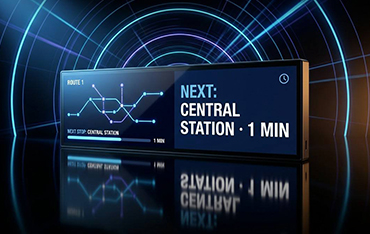
In today's business environment, digital signs have become an essential marketing and information delivery infrastructure in various business scenarios.
Most business decision-makers face the same dilemma: can new, similarly designed televisions fulfill the tasks of digital signage?
From a short-term perspective, this seems like a good alternative, but fundamental differences in technology often lead to various after-sales problems later on.
This article will compare and contrast digital signage from multiple dimensions, including panel technology, heat management, and brightness, based on the latest industry practices and new trends in digital signage technology, to provide relative selection suggestions and help businesses achieve optimal display marketing and information delivery solutions.
Core Definition And Commercial Value Of Commercial Digital Signs
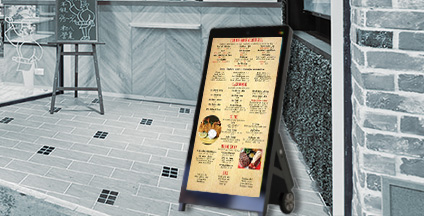
Commercial digital signs are display terminals specifically designed for public commercial environments. They are primarily used for advertising, event announcements, product marketing, and navigation.
Essentially, they are "pure display + signal input" devices and require a CMS (Content Management System), media player, or external components to operate efficiently.
Unlike consumer electronics devices, commercial signage displays are designed for "24/7 high-intensity stable operation" and "adaptability to complex environments," aiming to enable continuous content marketing and information delivery through dynamic content display in various commercial scenarios.
Common Application Scenarios For Commercial Digital Signs
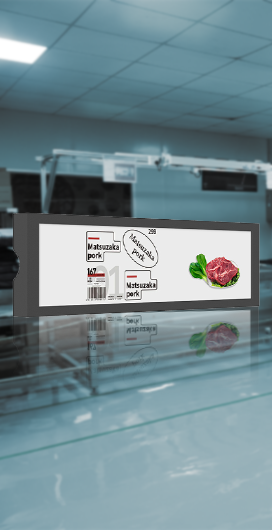
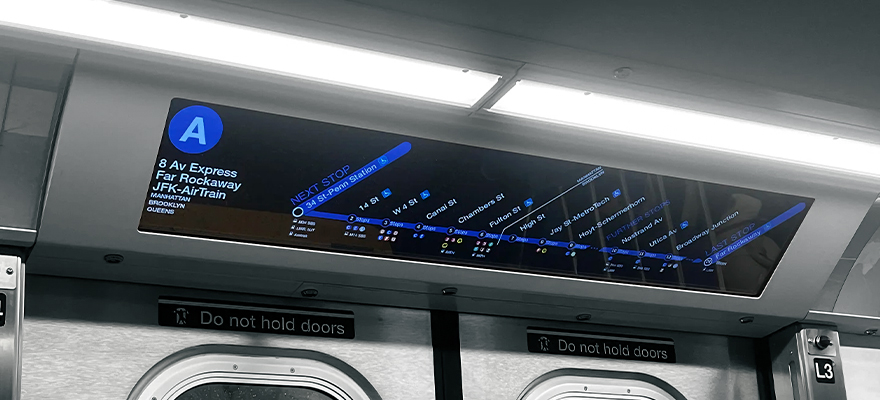
Digital signage has now deeply penetrated various high-traffic venues, creating an advertising space for businesses that allows for rapid reach without disturbing customers.
It provides information sources for those who need them, and typical application scenarios include:
Shopping malls and supermarkets
Airports and transportation hubs
Bus stops and city center squares
Sports stadiums and cinemas
Bank lobbies and museums
The Main Differences Between Commercial Digital Signs And Television
System Integrity: A television is a home entertainment device, integrating the tuner, operating system, and speakers, allowing for independent program viewing; commercial digital signage is more like a standalone display screen, requiring an external signal source.
Audio Configuration: Televisions come standard with built-in sound systems, while commercial digital signage is added on demand, requiring customization based on different business scenarios.
Display Performance: Digital signage generally has higher pixel density, suitable for viewing from a distance; televisions are more geared towards home entertainment at close range.
Operating Mode: Commercial equipment supports flexible switching between portrait and landscape modes and 24/7 continuous operation, while consumer-grade televisions are prone to overheating and burn-in issues in commercial environments.
Commercial Digital Signs And In-depth Comparison With Television
Brightness And Anti-glare Performance
Typical television brightness ranges from 250-400 nits (some high-end models can reach 1000 nits, but this cannot be maintained continuously). In bright environments, the image is likely to become difficult to view due to ambient light.
Indoor digital display signs typically have a brightness of 300-700 nits, while outdoor digital advertising signs designed for bright environments can reach 1500-3500 nits or more. Furthermore, digital signs are usually equipped with anti-glare coatings to ensure readability.
Service Life
Television panels are typically designed for a lifespan of 20,000-30,000 hours, with continuous use time generally ranging from 8 to 12 hours.
Commercial digital signage uses industrial-grade panels with a rated lifespan of 50,000-100,000 hours, supporting 16/7 or 24/7 continuous operation, suitable for year-round commercial scenarios.
Cooling System
Televisions use basic cooling systems, which are prone to overheating, automatic frequency reduction, and even hardware damage under prolonged high loads.
Commercial digital signage is equipped with enhanced active cooling, featuring cooling fans, high-quality power modules, and high-temperature resistant components, effectively controlling system temperature and preventing performance degradation.
To facilitate a clear comparison, I have created a table comparing televisions and commercial digital signage.
|
Commercial Digital Signs
|
TVs
|
Brightness
|
500-700+ (high-end 2500+)
|
250-400 (maximum 1000)
|
Service Life
|
50,000-100,000 hours
|
20,000-30,000 hours
|
Daily Runtime
|
16-24 hours
|
8-12 hours
|
Cooling System
|
Active Enhancement
|
Passive Basic Type
|
Warranty (Commercial Use)
|
3-5 years
|
1-2 years
|
Latest Digital Signage Technology Trends
Currently, the most popular technology for digital signage is Mini-LED backlighting, which provides commercial displays with more local dimming zones, lower power consumption, and higher contrast.
Although Micro-LED is still in the high-end pilot stage, it has begun to show its potential in ultra-large screen and transparent display applications.
In comparison, although consumer TVs have made significant progress in entertainment experience, they still have obvious shortcomings in commercial continuous operation and professional integration.
Advantages And Disadvantages Of Commercial Digital Signs
Main Advantages
Strong Visual Appeal: The high-brightness screen combined with dynamic visuals quickly captures attention from a distance, far surpassing static posters.
Flexible Content Updates: Software control allows for content updates across the entire network within minutes, eliminating the need for manual material changes.
High Space Utilization: Supports multiple content loops, equivalent to the effect of multiple traditional advertising spaces.
Significant Long-term Returns: While the initial investment is higher, precise marketing and repeated exposure lead to higher brand value and sales conversion rates.
Potential Shortcomings
Excessive information overload may distract viewers.
Initial procurement and installation costs are high.
Regular maintenance and professional training are required, necessitating significant effort in the initial stages of operation.
Advantages And Disadvantages Of Using Television As Digital Signage
Merits
Full-featured: Can be used as an entertainment device without additional software, suitable for small rest areas or temporary settings.
Low Initial Cost: The purchase threshold is much lower than professional equipment, suitable for startups with limited budgets.
Built-in Speakers And Brightness Adjustment: Simple operation; parameters can be adjusted directly and videos can be played.
Obvious Shortcomings
High long-term Operating Costs: Higher power consumption (brightness, sound, and tuner operate simultaneously), frequent maintenance, and significantly shortened lifespan.
Poor Commercial Adaptability: Not designed for 24/7 operation; prone to failure in bright environments or during prolonged operation; manufacturer warranties often do not cover commercial scenarios.
Limited Content Management: Lacks professional CMS support, resulting in low update efficiency and inability to achieve remote monitoring and batch scheduling.
Weak Scalability: Difficult to meet commercial requirements such as vertical screen installation and high-brightness outdoor applications.
Long-term Cost And Return On Investment Considerations
On the surface, televisions seem more "cost-effective," but in the long run, they actually incur higher costs.
Televisions typically need to be replaced within 1-2 years in a commercial environment, while commercial digital signage can operate stably for 3-5 years or even longer.
Considering factors such as maintenance, energy consumption, and installation labor, adopting commercial digital signage can often achieve cost recovery within 18-24 months.
Practical Recommendations:
1. For daily operation exceeding 12 hours, high-brightness environments, or environments requiring remote management → prioritize commercial digital signage.
2.For small indoor spaces with short-duration auxiliary scenarios → televisions can serve as a temporary solution, but a replacement budget must be reserved.
Evaluation Focus: It is necessary to analyze the usage scenario, whether it is a short-term or long-term plan, and whether it is to display entertainment content or customized marketing advertisements, etc., to determine which device to use.
Conclusion
At this stage, commercial digital signage is no longer simply a large screen, but rather the infrastructure for corporate digital marketing.
It surpasses traditional television in content flexibility, visual impact, and long-term stability. While using television may save some budget in the short term, from the perspective of brand image or long-term planning, using commercial digital signage is a wiser choice.
FAQ
Q:Can A TV Be Used For Digital Signage?
A:If it's a short-term project and the application scenario is indoors, a TV can be used for digital signage. However, if it's a long-term project and the scenario is well-lit, commercial digital signage is the optimal solution.
Q:Is Content Updating And Remote Management Feasible When Using Tvs For Signage?
A:Yes, it is feasible, but extremely inefficient. TVs require additional third-party software to barely achieve updates. Digital signage, on the other hand, natively supports professional CMS systems, enabling remote batch scheduling and multi-screen synchronization, offering significant advantages for large-scale operation.