Display technology is now widely used in various fields, from industrial handheld terminals and automotive display systems to medical monitoring equipment, all requiring display technology to present images. Among display technologies, TFT-LCD remains the mainstream choice in the market.
However, liquid crystal molecules themselves do not possess the ability to emit light; they are more like valves controlling light. The core that truly gives the screen brightness and color performance lies in the backlight module behind the LCD panel.
This article will dissect the TFT backlight module from an architectural perspective, unlocking the optical mysteries behind TFT-LCD.
The Principle Of Backlit Light Emission In TFT-LCD
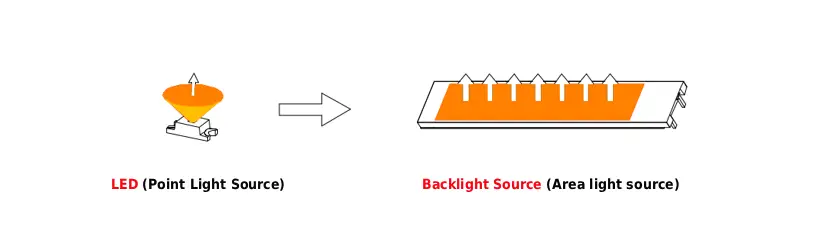
The primary task of the LED backlit system in the entire TFT-LCD display is to convert the point light source emitted by the LED strip into a surface light source that can uniformly cover the entire TFT-LCD panel. This step involves sophisticated optical principles.
The Principle Of Optical Conversion In TFT-LCD Backlight Modules
Backlight modules require a combination of other optical films to convert the light source itself. First, the light emitted from the LED strips needs to enter the light guide plate. According to the principle of reflection, the light undergoes repeated reflections inside the light guide plate.
Next, the dot matrix of the light guide plate disrupts the total internal reflection condition, scrambling the original propagation path and allowing the light to exit from the front of the light guide plate. It's important to note that the dot density is not uniform; the dots near the LED light source are typically smaller and sparser, while the dots gradually increase in size and density further away from the light source.
Subsequently, after multiple corrections by diffusion and brightness enhancement films, the chaotic propagation direction is guided to a direction perpendicular to the LCD panel, thus ensuring the uniformity of light transmission to the TFT-LCD panel.
Common Backlight Light Emitting Structures
In practical applications, backlight structures are mainly divided into two technical routes: direct-lit backlight and edge-lit backlight.
Direct-lit Backlight
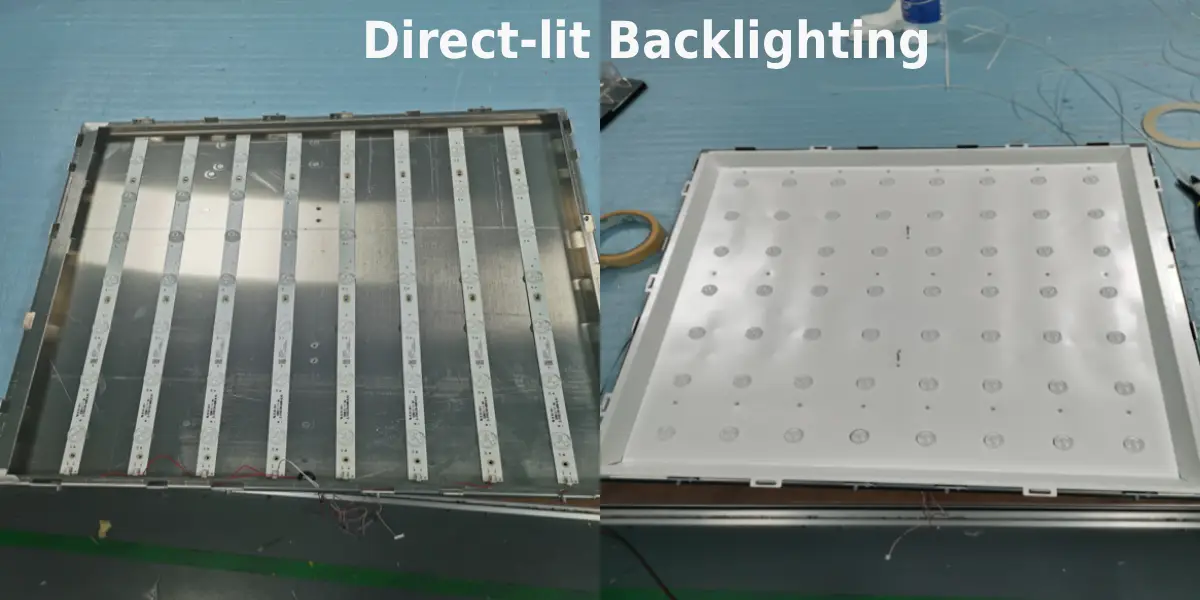
In a direct-lit backlight module, the LED strips are arranged at the bottom of the back panel, allowing the light to be emitted directly upwards.
This structure achieves extremely high brightness and uniformity without requiring overly complex light guide dot designs.
However, it results in a thicker module and requires a larger number of LED chips, leading to relatively higher costs.
Edge-lit Backlight
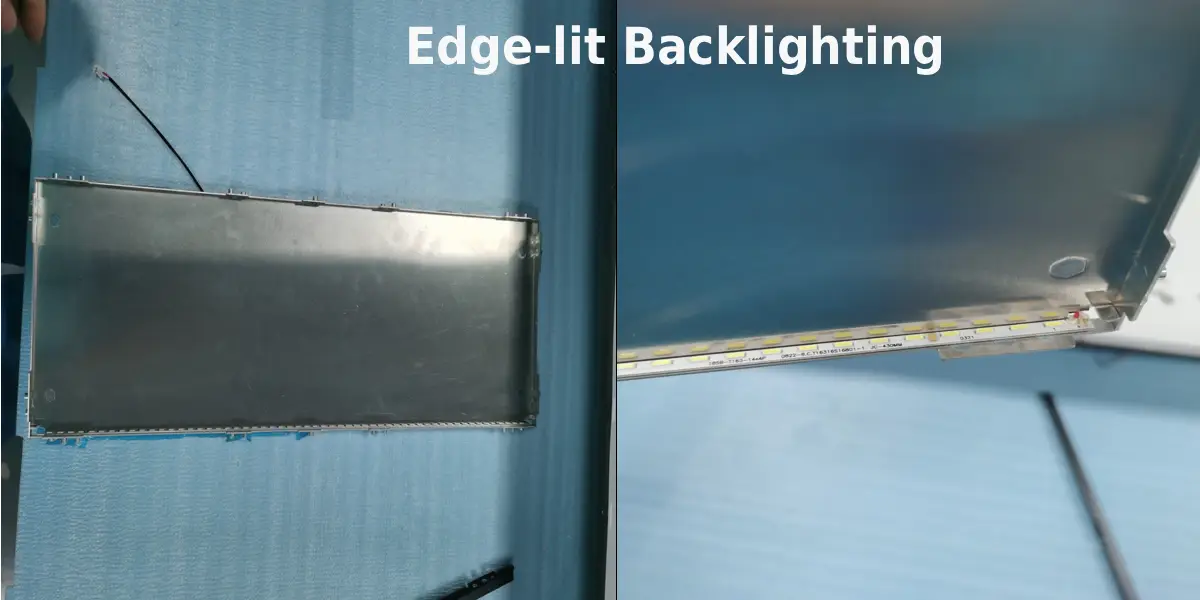
Edge-lit backlighting involves placing LED strips on one or both edges of the back panel, and achieving surface emission through the guidance of various optical films.
This design allows the entire display module to be thinner, but it is not as good as direct-lit backlighting in terms of brightness uniformity and local contrast.
Materials Used In Backlight Modules
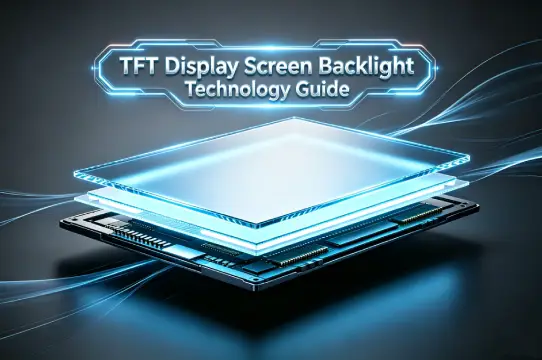
A complete TFT LCD backlight is made up of a stack of various optical films and precision components, with each layer playing an irreplaceable role in the optical propagation path.
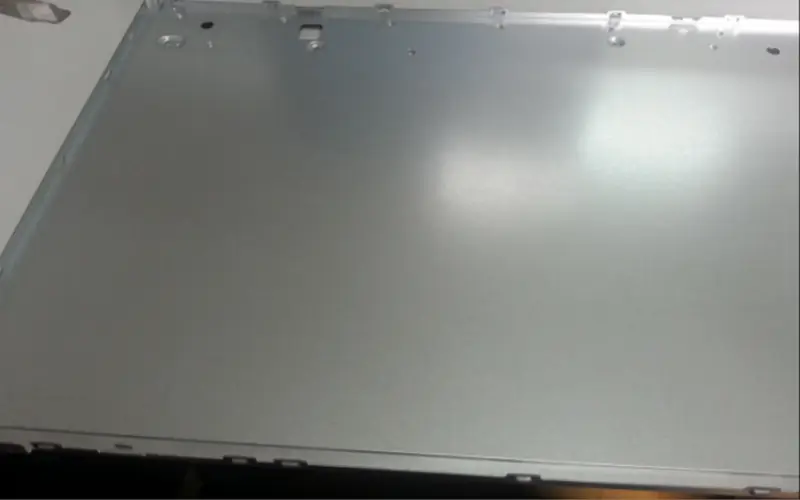
Backplate
The backplate is the skeleton of the entire backlight module. It mainly provides positioning reference and support for the entire backlight module, and also has the functions of blocking and reflecting light. In direct-lit light emission schemes, the backplate also needs to take into account heat dissipation.
LED Light Strips
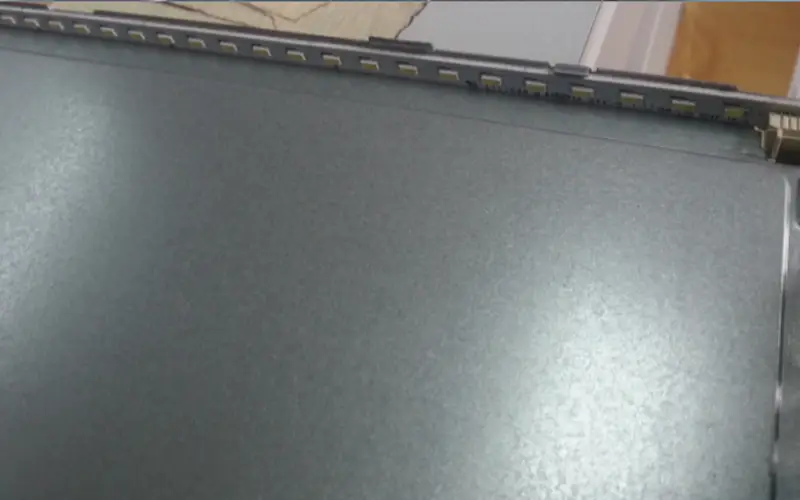
LED light strips are a key component for the entire display screen's light emission and the power source for the entire module.
They are usually attached to the back panel. Currently, white LEDs are the mainstream in the market, but in the high-end display field, RGB three-color LEDs or Mini LED solutions are gradually penetrating to achieve wider color gamut coverage and more refined dimming zones.
Light Guide Plate
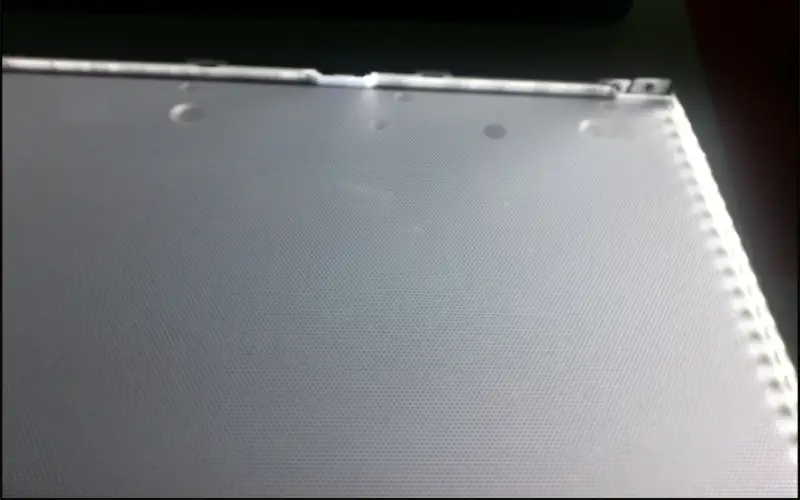
The light guide plate is the optical core of a side-lit backlight system.
In addition to the dot design mentioned earlier, modern light guide plates also involve more advanced microstructure technology.
These microstructures can pre-adjust the light emission angle while breaking total internal reflection, reducing the light loss of subsequent optical films.
Reflective Film
The function of the reflective film is to capture light escaping from the bottom of the light guide plate and reflect it back into the light guide plate, thereby improving the overall light efficiency, maximizing light utilization, and reducing energy consumption.
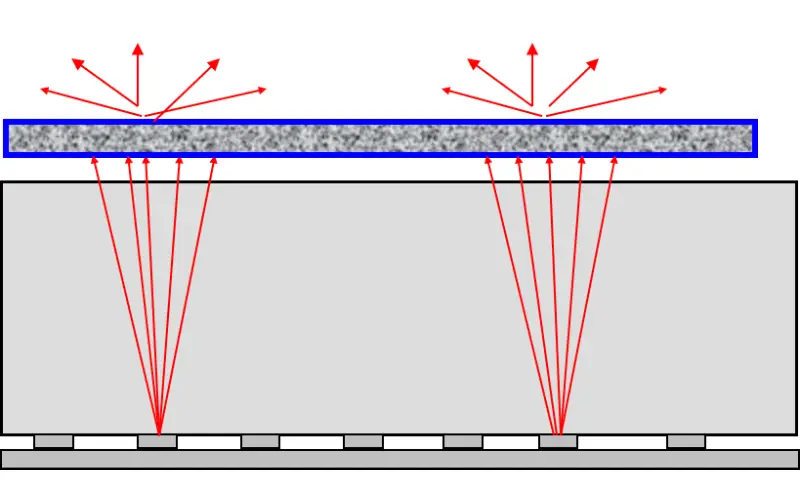
Diffuser Film
Light emitted from the light guide plate still retains strong directionality, and the dot pattern at the bottom of the light guide plate may be visible to the naked eye.
The diffuser achieves two goals through built-in diffuser particles (which scatter light multiple times): firstly, it widens the viewing angle, ensuring consistent brightness of the display image at different viewing angles; secondly, it diffuses the dot pattern of the light guide plate, eliminating visible pattern traces.
Brightness Enhancement Film
The brightness enhancement film is key to improving the brightness of the front of the screen. Its function is to focus the light diffused by the diffusion film within a certain angle range, thereby significantly improving the center brightness of the LCD screen and further enhancing the light efficiency.
Conclusion
The backlight module of a TFT display is a product of the perfect integration of optics, materials science, and mechanical structure.
From the initial LED point light source to the final uniform surface light source presented to the user, every step embodies precise optical calculations.
For display module procurement and R&D personnel, establishing a systematic understanding of backlight optical paths and material properties is the fundamental ability to make reasonable technology selections and control costs.