The "polarity inversion" technology in TFT-LCD liquid crystal display panels is the core of the driving circuit, directly determining the stability of the image, the controllability of power consumption, and the absence of flicker, crosstalk, or image retention.
Simply put, polarity inversion involves continuously changing the direction of the electric field between the pixel electrode and the Vcom common electrode while maintaining a constant voltage difference, thus achieving AC drive.
This not only controls the deflection of liquid crystal molecules to display different gray levels but also prevents screen burn-in.
Furthermore, it effectively suppresses common display defects such as image retention, crosstalk, and flicker.
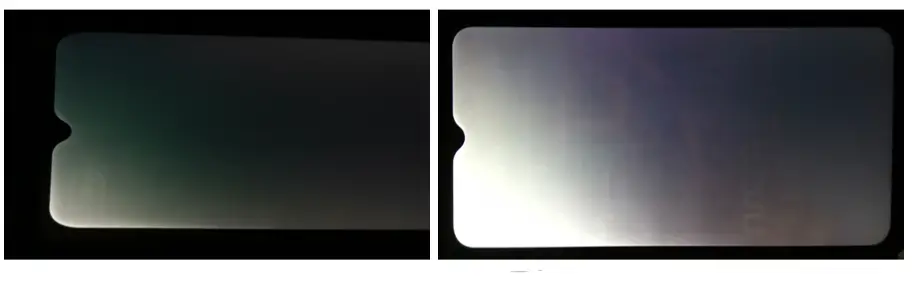
Why is polarity reversal so important? Because the electrical properties of liquid crystals mean they cannot withstand a fixed electric field for an extended period.
Otherwise, ions will accumulate at the poles, disrupting the normal deflection ability of the liquid crystal molecules and ultimately causing image abnormalities.
If the driving method is not chosen properly, even with excellent panel hardware, visible problems can easily occur in practical applications, especially in low refresh rates, large screen sizes, or high grayscale transition scenarios.
These problems not only affect user experience but also directly increase after-sales costs and brand risk.
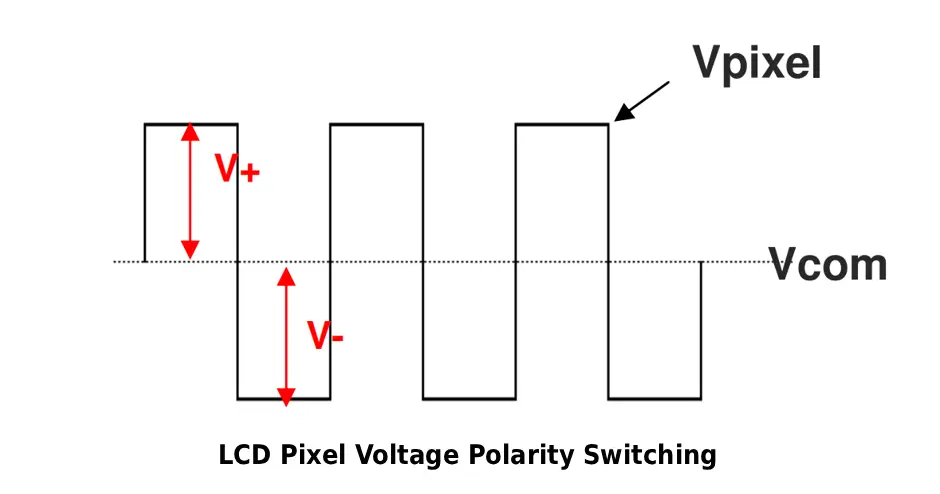
This article will provide a clear comparative analysis from the perspectives of working principles, advantages, and disadvantages, helping you to develop rapidly in the LCD display industry.
Frame Inversion
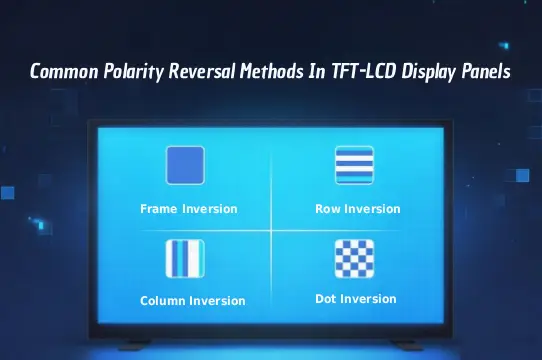
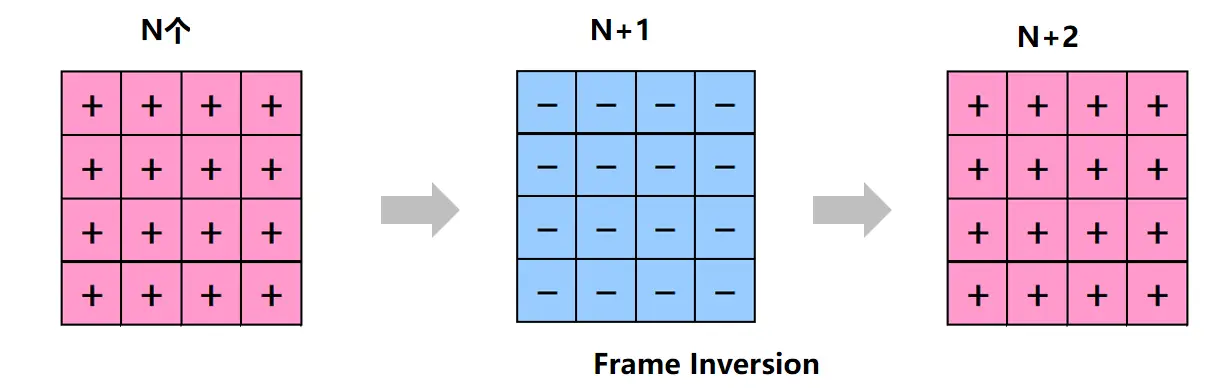
Frame inversion is the most basic driving method. Within the same frame, the polarity of all pixels on the screen is exactly the same. When switching to the next frame, the polarity of all pixels is flipped simultaneously.
Advantages Of Frame Inversion
Frame inversion requires only a single global polarity control signal, resulting in the simplest driving circuitry.
The data line only inverts once per frame, minimizing the frequency of parasitic capacitance charging and discharging, thus minimizing overall power consumption.
Furthermore, the Vcom voltage remains constant within the same frame; as long as the voltage difference between the pixel electrode and Vcom is correct, the image can be displayed correctly, making the requirements for Vcom voltage accuracy relatively relaxed.
Disadvantages Of Frame Inversion
According to the driving method of frame inversion, since the pixel polarity of the entire LCD panel changes synchronously, even a very small voltage deviation in Vcom will result in a significant difference in brightness between the Nth frame and the N+1th frame, leading to large-area flicker.
This problem is particularly prominent at low refresh rates, and it has become an almost unavoidable fatal flaw of frame inversion.
Row Inversion
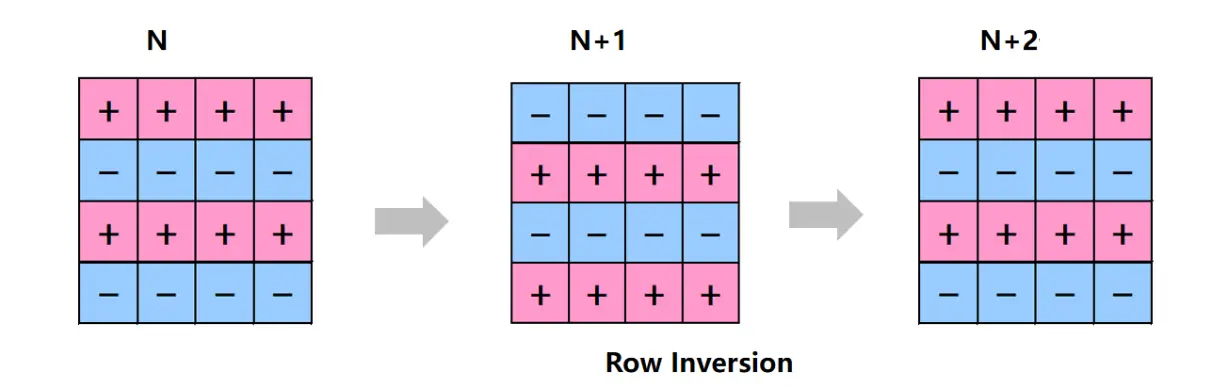
Row inversion refers to the reversal of pixel polarity in adjacent scan lines within the same frame (odd rows are positive, even rows are negative), with rows alternating. When switching to the next frame, the polarity of all rows is flipped.
Advantages Of Row Inversion
Adjacent rows have opposite polarities, which averages the brightness of the entire screen between two frames, greatly reducing the risk of flicker.
At the same time, the inter-row polarity interleaving also helps to alleviate vertical crosstalk. Compared with dot reversal, the data line only needs to be flipped once when switching rows, resulting in significantly lower power consumption,It is a cost-effective compromise.
Disadvantages Of Row Inversion
Because row inversion has the same pixel polarity across the entire row, horizontal line flickering can easily occur when the LCD screen switches from frame N to frame N+1 at low refresh rates.
Column Inversion
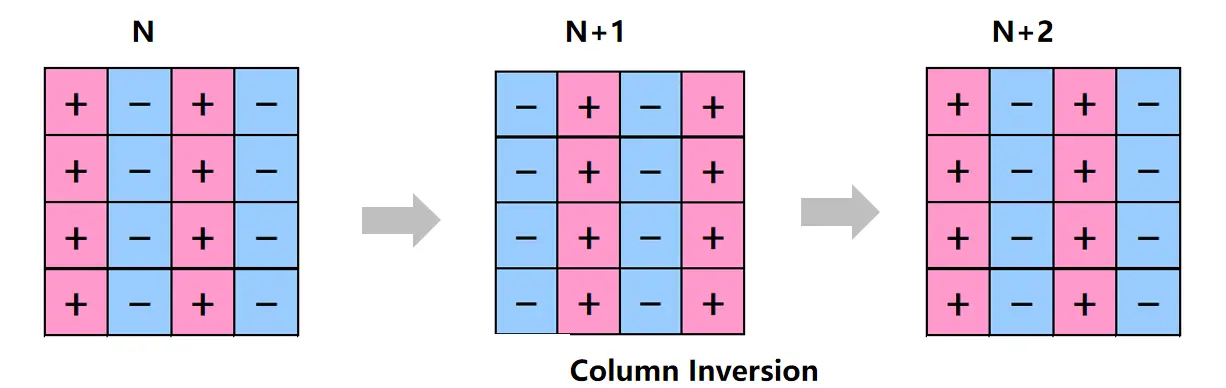
Column Inversion refers to the fact that adjacent data lines have opposite pixel polarities within the same frame, and the polarities alternate between columns.
When the screen switches to the next frame, the polarities of all columns will be flipped as a whole.
Advantages of Column Inversion
Column inversion and row inversion operate on very similar principles. Pixel polarity is staggered between columns, effectively averaging brightness between consecutive frames and reducing flicker risk. The staggered polarity between columns is particularly beneficial for improving horizontal crosstalk.
More importantly, there's the power consumption performance: with a fixed Vcom voltage, consistent pixel polarity within the same column results in smaller variations in the Source Driver output voltage, leading to a more stable charging process.
Compared to row inversion, column inversion consumes less power overall and is currently the most mainstream inversion method for small and medium-sized TFT-LCD panels, achieving a good balance between image quality and energy consumption.
Disadvantages Of Column Inversion
Because the polarity of all pixels in a column is the same, vertical line flickering is likely to occur when the LCD panel switches from frame N to frame N+1. This phenomenon is more likely to occur in products with lower refresh rates.
Dot Inversion
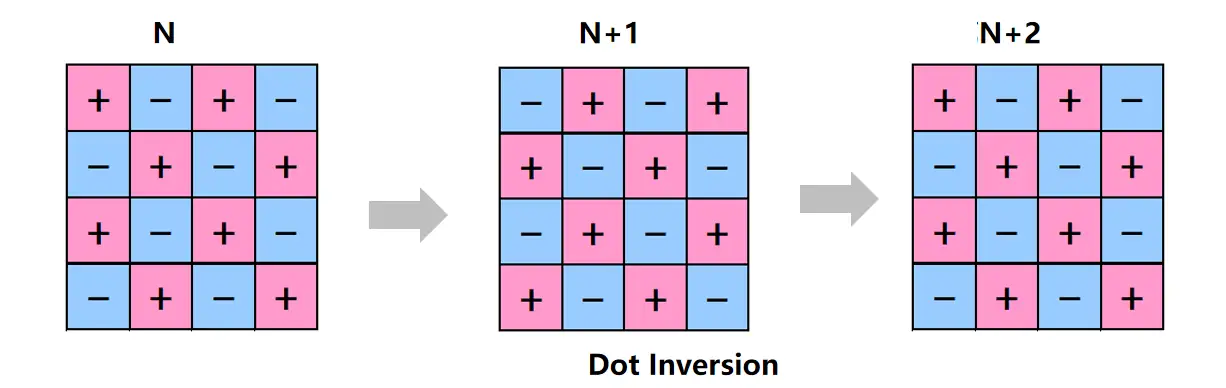
Dot inversion is the most precise polarity distribution among the four methods. It means that within the same frame, the polarity of each pixel is opposite to that of its four adjacent pixels above, below, left, and right, forming a checkerboard-like polarity distribution. When the frame changes to the next frame, the polarity of all pixels is flipped as a whole.
Advantages Of Dot Inversion
Because each pixel is surrounded by neighbors of opposite polarity, local electric field interference is almost completely neutralized.
Therefore, screen flicker and horizontal/vertical crosstalk are extremely rare, resulting in the best display uniformity and the highest color reproduction and accuracy among the four methods.
Disadvantages of Dot Inversion
The disadvantages of dot inversion are also obvious: high power consumption. The polarity of the data line must be reversed with each row switch, and adjacent channels within a row must also be reversed, causing large voltage fluctuations.
The dynamic power consumption is usually more than twice that of row inversion. In commercial products with extremely high power consumption requirements, the use of dot inversion is significantly limited.
Conclusion
Understanding the four polarity inversion methods of TFT-LCDs is a key indicator for selecting commercial displays.
Frame inversion is suitable for minimalist, low-power scenarios; row inversion and column inversion strike a balance between cost-effectiveness and stability; while dot inversion provides ultimate performance for high-definition medical and professional applications.
Choosing the appropriate driving method can significantly improve product reliability, reduce power consumption, and minimize after-sales issues.