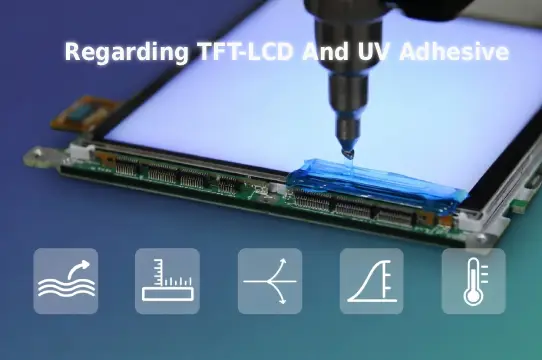
We are a manufacturer of commercial LCD displays, and we use UV adhesive on our production line every day. Although it's just an auxiliary material in the production of LCD displays, it significantly impacts module yield, reliability, and the lifespan of the final product.
Different parts have vastly different requirements for UV adhesive. Today, based on our industry experience, we will describe the key indicators in TFT-LCDs, hoping to provide you with some assistance.
Regarding The Viscosity Of UV Adhesives
Viscosity directly determines the flowability and coating effect of UV adhesives on dispensing equipment. In LCD module production lines, viscosity that is too high or too low will result in significant differences.
Advantages of Higher UV Adhesive Viscosity
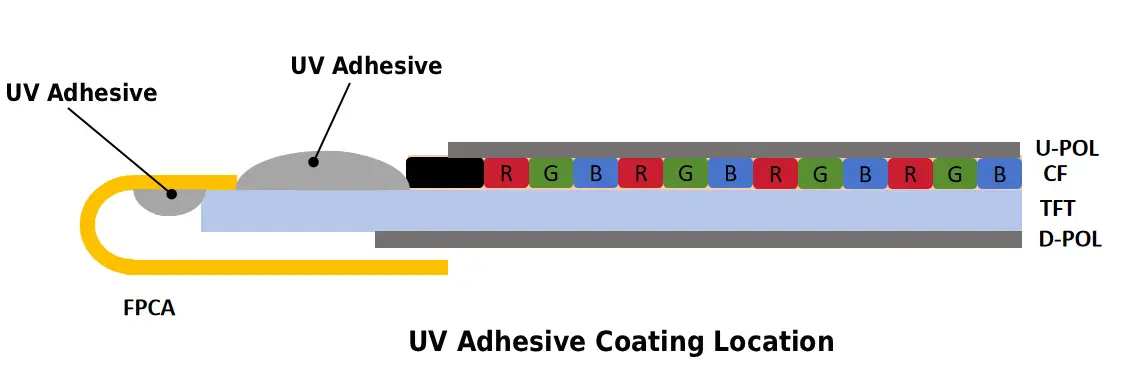
Higher UV adhesive viscosity makes it easier to control the width and thickness during coating, which is crucial for UV line adhesives used in the bonding of LCDs and FPCs.
The width of the UV line adhesive affects the bending radius of the FPC, preventing the UV adhesive from flowing onto the back of the TFT glass. It also reduces excessive flow when used as a surface adhesive, lowering the risk of air bubbles during subsequent OCA optical adhesive bonding.
Disadvantages Of High Viscosity UV Adhesive
While the advantages of high viscosity UV adhesive have been described above, it also has its drawbacks. Increased viscosity makes dispensing more difficult, affecting dispensing efficiency; uneven coverage may occur in the adhesive area; and terminal circuits are prone to corrosion and burns after testing.
The advantages and disadvantages of UV adhesives with lower viscosity are the opposite of those with higher viscosity. Generally speaking, lower viscosity UV adhesives dispense more smoothly and have better coverage, but control over the height and thickness is more difficult, and the risk of adhesive overflow and contamination is higher.
To ensure the coating effect of UV adhesives and improve product stability, strictly speaking, UV topcoats require a slightly lower viscosity, while UV line adhesives require a slightly higher viscosity.
Currently, many UV adhesive suppliers have optimized their viscosity to the 330~350 mPa·s@25℃ range, enabling multiple uses with a single adhesive and significantly reducing inventory and management costs.
UV Adhesive Shore Hardness
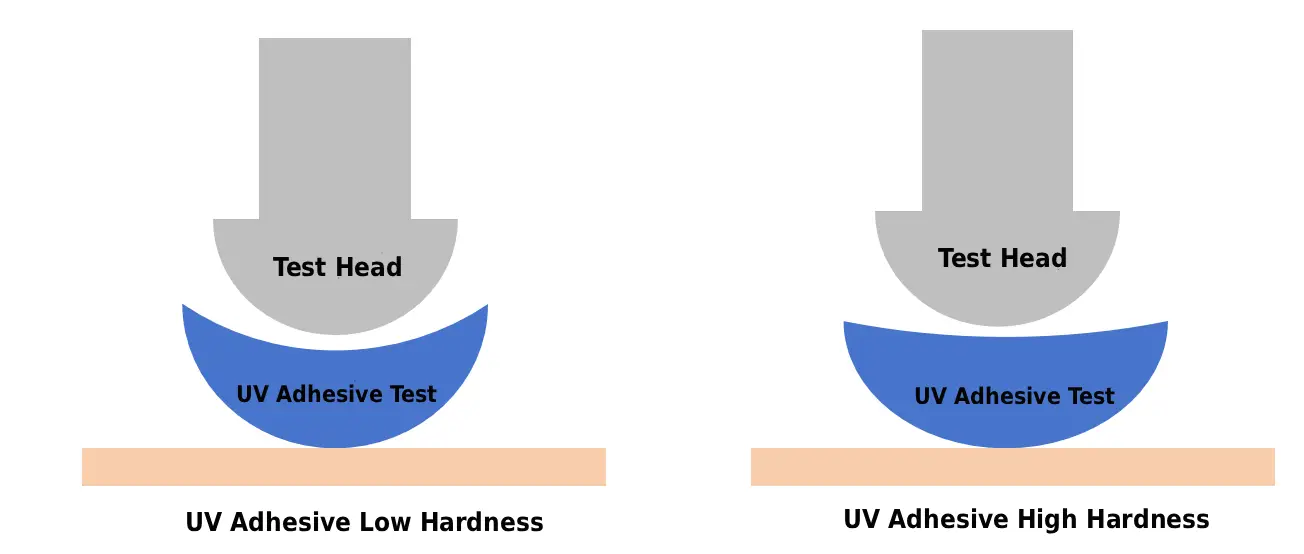
The hardness listed in UV adhesive specifications usually refers to "Shore hardness," which reflects the adhesive film's resistance to indentation—a higher number indicates greater hardness, and vice versa.
If the UV adhesive's hardness is too high, the internal stress of the film increases, making it brittle. This reduces the adhesion to LCD glass and FPC, significantly increasing the risk of delamination and cracking after thermal cycling and damp heat testing.
If the UV adhesive's hardness is too low, insufficient cross-linking may occur, potentially leading to creep and gradual strength loss over time.
We uniformly recommend a Shore D of 25-50 for both surface and line adhesives in TFT-LCD modules. This range offers good toughness, reliable adhesion, and the lowest probability of after-sales issues.
UV Adhesive Water Vapor Transmission Rate
Water vapor transmission rate is a core metric for measuring the ability of a UV adhesive film to block moisture, and it's usually specified in the datasheet.
A higher UV adhesive water vapor transmission rate indicates poorer film density and weaker waterproofing. In high-temperature and high-humidity reliability tests, the risk of product defects is higher. Conversely, a lower value indicates better waterproofing performance.
This metric is related to coating thickness, test temperature, humidity, and duration—for the same adhesive, a thicker film results in a lower water vapor transmission rate.
When selecting a product, pay attention to two points:
① Don't just focus on the values on the specifications; be sure to ask under what testing conditions the results were obtained.
② If you encounter waterproofing issues and don't want to change the adhesive type, you can appropriately increase the coating thickness and control air bubbles during the coating process to significantly improve the waterproofing effect.
The testing principle is actually not complicated: the device has two chambers, one with high humidity and the other with low humidity, with the UV adhesive film sample sandwiched in between. Water vapor passes through the sample driven by the humidity difference, and the transmittance is calculated via an electrical signal after 24 hours.
UV Adhesive Elongation At Break
Elongation at break is a core indicator of the "toughness" of UV adhesives. It's the ratio of the increase in length when the adhesive film breaks to its original length. A higher value indicates a softer adhesive that can be stretched without breaking.
In LCD back-end manufacturing, after conductive silver paste is applied, a UV topcoat is often applied. If the silver paste needs rework, the topcoat must be removed.
UV adhesives with an elongation at break >100% are less prone to breakage during removal, leaving less residue and resulting in higher rework efficiency.
While UV line adhesives are less frequently reworkable, their high elongation also better withstands repeated bending of FPCs, reducing breakage caused by bending stress.
In actual selection, we prioritize adhesives with high elongation, which not only improves production maintainability but also indirectly enhances the overall module reliability.
UV Adhesive Glass Transition Temperature
The glass transition temperature (TG) of UV adhesive is a core thermodynamic parameter, representing the critical point at which the adhesive film transitions from a "glassy" state (hard and brittle) to a "highly elastic" state (soft and flexible).
Below the TG, the adhesive film is hard and brittle; above the TG, it becomes soft and elastic. Since FPC bonding areas require bending, the TG of the UV adhesive must be significantly lower than the product's minimum operating temperature (e.g., below -20°C) to ensure flexibility. Some adhesives can achieve a TG of -28°C, making them particularly comfortable to use at room temperature.
It is particularly important to note that LCD modules often involve cryogenic repair (disassembling the OCA at -60°C to -70°C) and low-temperature storage. If the TG is too high (e.g., 64°C), the adhesive film will crystallize and become brittle under low-temperature conditions, making it highly susceptible to freeze-thaw cracking.